



18
June 2026
From Refinery to Runway: How Fuel Reaches the Fleet of the Air France-KLM Group’s Airlines
Behind every departure, carefully sourced, tested, and transported aviation fuel needs to reach the tanks of Air France, KLM and Transavia aircraft. Its transport is the result of a supply chain spanning oilfields, refineries, ports, and hundreds of kilometers of underground pipelines. Let's take a closer look at that journey that is essential to air transport.

Crude oil and refining: where jet fuel begins
Jet fuel starts as crude oil, extracted from oilfields around the world. Unlike road fuels, Jet A-1 is produced to exceptionally tight specifications: it must meet strict requirements on flash point*, freezing point, viscosity, and energy density to perform reliably at cruising altitudes where temperatures can drop below -50°C.
European airports draw their supply from a broad and deliberately diversified range of origins. Domestic European refineries, including major facilities in France and the Netherlands, provide a significant share of the continent's needs, supported by imports. Before the crisis, around 25% of jet fuel consumption in Europe was imported from the Middle East. New logistics routes, namely from North America and West Africa, are now in place to increase supply from these regions to Europe.
While recent tensions in the Middle East have put upward pressure on prices, the multitude of supply routes and the depth of storage infrastructure in Europe strengthen the resilience of Air France-KLM's supply chain in the face of any regional disruptions.
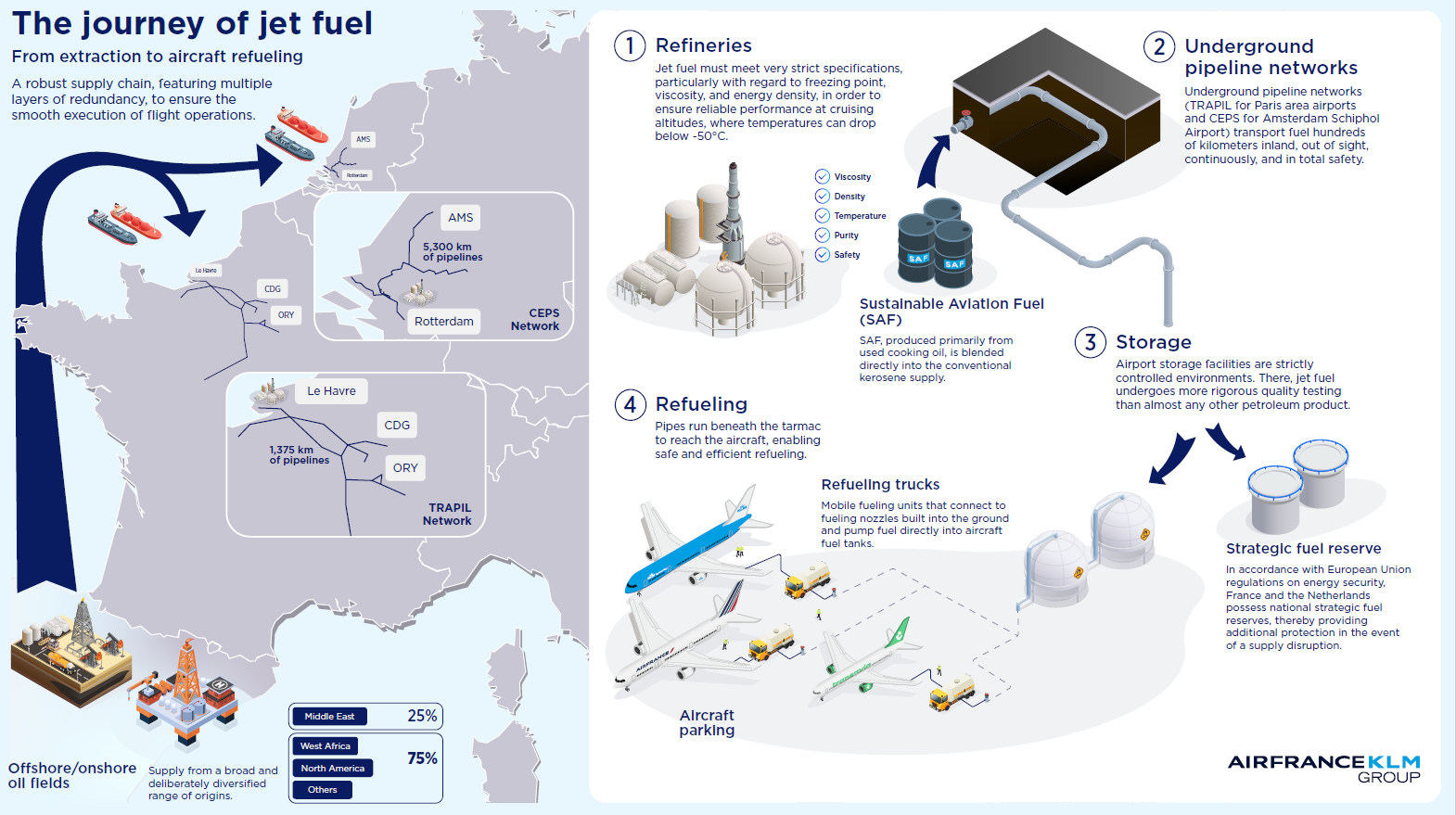
From port to aircraft: getting fuel to Europe
Once refined, the vast majority of jet fuel travels by sea in large tankers to major receiving ports. From there, dedicated underground pipeline networks carry fuel hundreds of kilometers inland, invisibly and continuously.
To supply its main European hubs, Air France-KLM relies on two main pipeline systems that serve Paris-Charles de Gaulle, Paris-Orly, and Amsterdam-Schiphol.
Paris area airports are supplied entirely by the TRAPIL underground pipeline system, spanning 1,375 km, which connects the port of Le Havre and the refineries of Normandy to storage depots that supply the Paris airports. An underground pipeline network then distributes the fuel directly to aircraft stands.
The Amsterdam-Schiphol hub is supplied by the Central Europe Pipeline System (CEPS), a network covering approximately 5,300 km that connects the Netherlands, Belgium, Luxembourg, France and Germany. Fuel is drawn from refineries and storage terminals in the Rotterdam Europoort area. The fuel is then pumped to Schiphol via the Amsterdam Schiphol Pipeline (ASP).
Before entering the pipeline, Sustainable Aviation Fuel (SAF), produced mainly from used cooking oils, is blended with conventional jet fuel. This “drop-in” fuel can be used with no changes to aircraft, engines, or infrastructure, all while offering the same performance and safety guarantees.
Beyond airport-level reserves, both France and the Netherlands maintain strategic national fuel reserves. These reserves, required under European energy security regulation, can be deployed in case of prolonged supply disruption. Managed at the national level, these reserves are complementary to those held by airport operators, thereby reinforcing the supply chain’s resilience.
At the airport: storage, quality control, and fueling
When fuel arrives at an airport storage facility, it enters a strictly controlled environment. Jet fuel is among the most rigorously quality tested petroleum products in the world. Samples are analyzed at every stage of the journey: at the refinery, in the pipeline, all the way to the final dispenser truck, in conformity with international standards. The rule is simple: any fuel that does not meet requirements is immediately taken out of circulation and never reaches an aircraft.
At Paris-Charles de Gaulle and Amsterdam-Schiphol, a vast underground pipeline network transports fuel directly under the ramp and aircraft fueling areas. A detail that often surprises: the vehicles on the tarmac are typically not tankers carrying fuel in their tanks. Instead, they are mobile pumping units, which connect to hydrants built into the ground at each stand and directly pump fuel into aircrafts’ tanks situated in the wings. Conventional tanker trucks remain available as a backup.
Before each departure, the quantity of fuel brought onboard is precisely calculated in relation to the planned route, weather conditions, and the regulatory reserves required to ensure flight safety.
A robust supply chain to ensure operations
At the European level, traders continuously adjust their supplies based on needs and market conditions, drawing on a variety of sources.
As for airlines themselves, they do not typically stockpile significant fuel reserves of their own. Air France-KLM purchases from a range of suppliers, including at the same airport, and is not dependent on a single worldwide provider. Procurement and availability monitoring are handled by dedicated in-house fuel teams, which tracks supply conditions with all suppliers and at every station across the network.
Since the recent tensions in the Middle East, monitoring of jet fuel availability is done on a weekly basis in coordination with fuel suppliers and local authorities.
Behind every flight unfolds a discreet yet essential supply chain, designed to guarantee the security of fuel supplies and support the gradual integration of sustainable aviation fuels. An ever-evolving infrastructure, serving the continuity of operations and the decarbonization of air transport.
* The flash point of a material is the lowest liquid temperature at which, under certain standardized conditions, a liquid gives off vapors in a quantity such as to be capable of forming an ignitable vapor/air mixture.
Sustainable Aviation Fuel (SAF): a transition already underway
A growing share of the fuel used by Air France-KLM consists of Sustainable Aviation Fuel (SAF). Produced notably from used cooking oils and other renewable feedstocks, this fuel reduces CO₂ emissions across its entire life cycle.
Blended with conventional jet fuel at the logistical infrastructure level, SAF is described as "drop-in" fuel, meaning it can be used immediately, without any modification to aircraft, engines, or existing infrastructure. Its gradual integration into supply networks represents one of the key levers for decarbonizing air transport.


We recommend these articles
to continue reading:
